EPOCH
Dual-Output 12V/36V Marine DC-DC Charger | Charge on the Run
Dual-Output 12V/36V Marine DC-DC Charger | Charge on the Run
Couldn't load pickup availability
Epoch Dual-Output 12V & 36V Marine DC-to-DC Charger | Charge on the Run
Charge two auxiliary voltage systems from one source.
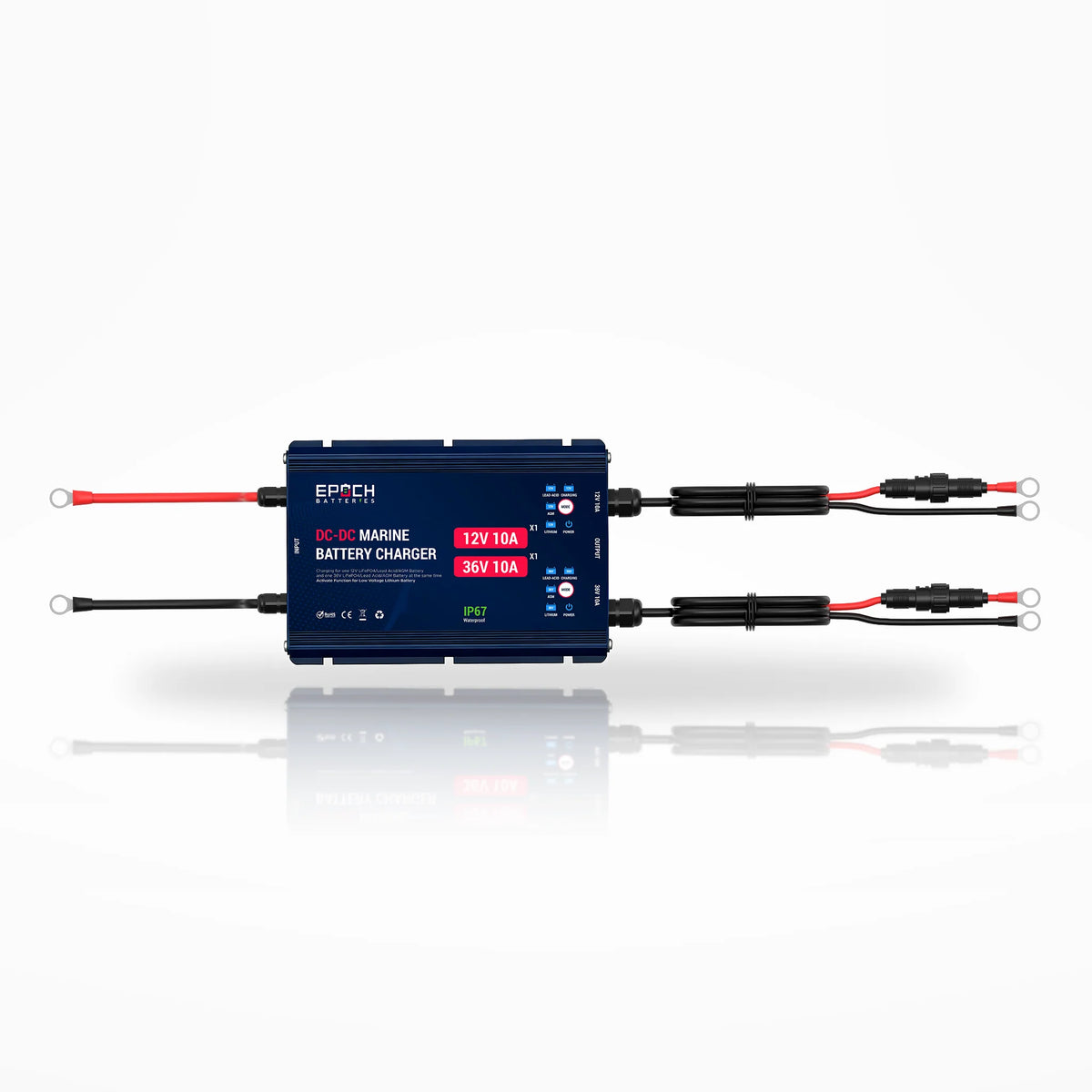
Turn engine-run time into usable charging power for both your 12V auxiliary battery and 36V trolling-motor battery with the Epoch CHG-DC-12V36V Dual-Output Marine DC-to-DC Charger.
Designed for compatible 12V or 24V starter-battery systems, this charger provides two independent outputs: 12V / 10A for a separate house, electronics, or auxiliary battery and 36V / 10A for a compatible trolling-motor battery.
Automatic voltage sensing controls charging based on source voltage, while selectable LiFePO4, lead-acid, and AGM profiles provide flexibility for different battery chemistries. An epoxy-filled IP67 enclosure, active cooling, built-in protection, and compact onboard mounting make it a practical solution for mixed-voltage marine power systems.
One source system. Two auxiliary voltage banks. More power between fishing spots.
Model: CHG-DC-12V36V
| 12V / 24V | Compatible source systems |
| 12V / 10A | Auxiliary output |
| 36V / 10A | Trolling-motor output |
| ~480W | Combined nominal output before losses |
| 3 charging modes | LiFePO4 / Lead-Acid / AGM |
| IP67 | Epoxy-filled enclosure |
| 2 independent banks | Separate 12V & 36V outputs |
| Non-isolated | Electrical architecture |
Charge on the Run
One charger for your 12V and 36V systems
Modern bass boats can have significant electrical demands.
12V electronics, accessories, and house loads are competing for energy while a 36V trolling motor is working hard at the front of the boat.
The CHG-DC-12V36V gives you a way to supplement both systems while the engine is running.
The charger monitors the source battery, converts available DC power, and provides two regulated auxiliary charging outputs:
- 12V / 10A for a separate 12V auxiliary battery
- 36V / 10A for a compatible 36V trolling-motor battery
Instead of connecting the batteries directly together, the DC-to-DC charger manages the energy transfer between the source and auxiliary systems.
Spend less time waiting for batteries to recharge and more time on the water.
Dual 12V & 36V Outputs
Charge two different voltage systems simultaneously
The two output banks are designed for separate auxiliary batteries.
12V / 10A Output
Use the 12V output for a compatible separate:
- House battery
- Electronics battery
- Accessory battery
- Secondary 12V battery
The 12V output provides approximately 120W of nominal charging power before conversion losses.
36V / 10A Output
Use the 36V output for a compatible:
- 36V trolling-motor battery
- 36V auxiliary battery
The 36V output provides approximately 360W of nominal charging power before conversion losses.
Approximately 480W of Combined Output
With both outputs operating at their full rated output, the charger can provide approximately 480W of aggregate nominal output power before conversion losses.
Actual charging performance depends on source voltage, alternator capacity, existing electrical loads, battery condition, cable sizing, voltage drop, and conversion efficiency.
Compatible With 12V or 24V Source Systems
The CHG-DC-12V36V accepts a compatible source system within its published 13–30VDC input range.
It can be used with compatible:
- 12V starter-battery systems
- 24V starter-battery systems
36V input batteries are not supported.
Automatic 12V Source Detection
For a 12V source:
- Charging starts above 13.8V
- Charging stops below 13.0V
Automatic 24V Source Detection
For a 24V source:
- Charging starts above 26.8V
- Charging stops below 25.2V
This voltage-based control allows the charger to recognize when the source system is being actively charged and stop charging when source voltage falls below the applicable threshold.
Smart Charging Without a Manual Trigger
The CHG-DC-12V36V automatically monitors the source voltage and controls the auxiliary charging process.
There is no published requirement for an ignition trigger, NMEA 2000 network, or proprietary communications hub.
After approximately 20 minutes at idle, the charger enters hibernation while continuing to monitor source voltage.
When the appropriate source voltage returns, charging can resume.
Selectable Battery Chemistry
Each output bank supports selectable charging profiles for:
- LiFePO4
- Lead-Acid
- AGM
This allows the 12V and 36V outputs to be configured independently according to the connected battery chemistry.
Always select the correct battery type before charging.
Battery chemistry should not be changed while the applicable output is charging. Disconnect the appropriate output ring terminals before changing the MODE setting.
Lithium BMS Activation
For a compatible sleeping lithium battery, select the appropriate LiFePO4 mode and hold the applicable MODE control for approximately 3 seconds to activate the battery's BMS.
Battery and BMS compatibility should always be confirmed before installation.
Harness Engine Power for More On-Water Runtime
Put engine-run time to work
The CHG-DC-12V36V can supplement both your 12V auxiliary system and 36V trolling-motor battery whenever the source charging system is active.
That can be especially useful during a long day of tournament fishing, when the boat is repeatedly running between spots.
However, the charger doesn't create free power.
A combined output of approximately 480W can create substantial demand on the source charging system, particularly when operating from a 12V source.
Before installation, verify:
- Alternator or charging-system output
- Starter-battery condition
- Existing electrical loads
- Available charging capacity
- Cable ampacity
- Cable length and voltage drop
- Fuse sizing
- Grounding
- Battery charging requirements
The charger should only be installed when the source charging system has sufficient capacity to support the additional load.
Built for Marine Environments
IP67 Epoxy-Filled Enclosure
The charger uses an aluminum housing filled with epoxy resin and carries an IP67 ingress-protection rating.
This provides a high level of protection for properly installed onboard marine applications.
IP67 does not mean the charger should be intentionally submerged or installed where it will remain underwater.
Protect the cables, ring terminals, connections, and cable entry points from unnecessary exposure to water, standing water, abrasion, and physical damage.
Active Cooling
This charger is not fanless.
The aluminum housing and bottom cooling plate work with a waterproof cooling fan to manage operating temperature.
Maintain more than 30mm of clearance around the charger and keep the fan and cooling surfaces unobstructed.
Secure Onboard Mounting
The compact 250 × 149 × 68mm enclosure uses 6.5mm mounting holes, with M6 fasteners recommended where appropriate for the mounting surface.
Mount the charger securely to a rigid surface and support the cables to prevent vibration, abrasion, or excessive strain.
Straightforward Onboard Installation
The charger has three connection groups:
- Source input
- 12V auxiliary output
- 36V auxiliary output
The connections use pre-wired ring terminals.
- Red = Positive
- Black = Negative
The red and black conductors within the same cable jacket must connect to the same battery.
The 12V output should connect to a separate 12V auxiliary battery and should not be connected back to the starter battery being used as the charger's input source.
The CHG-DC-12V36V is a non-isolated charger, so grounding, polarity, fusing, and battery connections must be carefully planned.
Always follow the supplied wiring diagram.
Non-Isolated System
Important wiring information
The CHG-DC-12V36V is non-isolated.
Voltage-sensing control does not provide galvanic isolation between the source and auxiliary systems.
Proper system design requires attention to:
- Battery polarity
- Common-negative/grounding architecture
- Fuse placement
- Cable sizing
- Voltage drop
- Battery configuration
- Cable routing
- Disconnects
Never connect a black lead to a terminal carrying red leads.
If you're unsure how the charger should be integrated into your boat's electrical system, contact Direct Current Boatworks before installation.
Ideal Applications
The Epoch CHG-DC-12V36V is designed for applications including:
- Bass boats with 12V electronics and a 36V trolling-motor system
- Tournament fishing boats that need supplemental charging while running between spots
- Mixed-voltage marine systems with separate 12V and 36V auxiliary batteries
- 12V electronics or house batteries that need supplemental charging
- 36V LiFePO4 trolling-motor batteries
- Compatible 12V and 36V AGM batteries
- Compatible 12V and 36V lead-acid batteries
- 12V or 24V source systems within the published input range
- Run-and-gun applications where engine runtime can supplement battery energy
Complete Your Dual-Output Charging System
The CHG-DC-12V36V works best as part of a properly engineered marine electrical system.
12V Auxiliary Battery
Use the 12V output with a compatible battery dedicated to electronics, house loads, or other 12V equipment.
Native 36V Trolling-Motor Battery
Use the 36V output with a compatible single 36V trolling-motor battery and the appropriate charging profile.
Dockside AC Charger
DC-to-DC charging supplements your battery system while underway. A properly sized AC charger should still be used for a complete dockside recharge.
Marine DC Protection
Use properly sized fuses, disconnects, conductors, and terminal protection for both output circuits and the source circuit.
Marine-Grade Wiring
Size conductors according to actual current, cable length, voltage drop, ambient temperature, and installation method.
Battery Monitoring
Monitor your starter, 12V auxiliary, and 36V trolling systems independently when detailed battery and energy information is required.
Technical Specifications
| Specification | Details |
|---|---|
| Brand | Epoch Batteries |
| Product | Dual-Output 12V/36V Marine DC-to-DC Charger |
| Model / SKU | CHG-DC-12V36V |
| Product Type | Two-bank, non-isolated marine DC-to-DC battery charger |
| Charging Banks | 2 independent output banks |
| Supported Source Systems | Compatible 12V or 24V starter-battery systems |
| Published Input Range | 13–30VDC |
| 36V Input | Not supported |
| 12V Start Threshold | Above 13.8V |
| 12V Stop Threshold | Below 13.0V |
| 24V Start Threshold | Above 26.8V |
| 24V Stop Threshold | Below 25.2V |
| 12V Output | 12V / 10A |
| 36V Output | 36V / 10A |
| 12V Nominal Output Power | Approximately 120W before conversion losses |
| 36V Nominal Output Power | Approximately 360W before conversion losses |
| Combined Nominal Output | Approximately 480W before conversion losses |
| 12V Battery Modes | LiFePO4 / Lead-Acid / AGM |
| 36V Battery Modes | LiFePO4 / Lead-Acid / AGM |
| Lithium BMS Activation | Hold applicable MODE control approximately 3 seconds |
| Automatic Hibernation | Approximately 20 minutes at idle |
| Manual Power Off | Hold MODE approximately 6 seconds |
| Wake | Short press MODE |
| Input Connections | Pre-wired ring terminals |
| 12V Output Connections | Pre-wired ring terminals |
| 36V Output Connections | Pre-wired ring terminals |
| Isolation | Non-isolated |
| Network Requirement | No published NMEA 2000 or proprietary network requirement |
| Short-Circuit Protection | Yes |
| Reverse-Connection Protection | Yes |
| Overcharge Protection | Yes |
| Overtemperature Protection | Yes |
| Cooling | Waterproof cooling fan |
| Housing | Aluminum housing with bottom aluminum cooling plate |
| Ingress Protection | IP67 |
| Enclosure Construction | Epoxy-filled |
| Working Temperature | -20°C to 40°C / -4°F to 104°F |
| Nominal Working Temperature | 25°C / 77°F |
| Dimensions | 250 × 149 × 68mm / approximately 9.84 × 5.87 × 2.68 in |
| Mounting Holes | 6.5mm |
| Recommended Fasteners | M6 |
| Required Clearance | More than 30mm |
| Published Weight | Not listed |
| Published Warranty | Not listed on current product information |
Alternator & Marine Safety Note
The CHG-DC-12V36V regulates energy transfer, but it does not eliminate the need for proper electrical-system design.
Before installation, confirm the source charging-system capacity, starter-battery condition, existing electrical loads, cable ampacity, voltage drop, fuse selection, grounding, battery compatibility, and cooling requirements.
Disconnect and isolate batteries before servicing the system.
Never charge a frozen, damaged, or unsupported battery.
Do not charge lithium batteries below 0°C / 32°F unless the battery manufacturer specifically approves charging at those temperatures or the battery incorporates an appropriate heating system.
Do not intentionally submerge the charger, regardless of its IP67 rating.
Epoch Dual-Output 12V & 36V Marine DC-to-DC Charger | Charge on the Run
Charge two auxiliary voltage systems from one source.
Turn engine-run time into usable charging power for both your 12V auxiliary battery and 36V trolling-motor battery with the Epoch CHG-DC-12V36V Dual-Output Marine DC-to-DC Charger.
Designed for compatible 12V or 24V starter-battery systems, this charger provides two independent outputs: 12V / 10A for a separate house, electronics, or auxiliary battery and 36V / 10A for a compatible trolling-motor battery.
Automatic voltage sensing controls charging based on source voltage, while selectable LiFePO4, lead-acid, and AGM profiles provide flexibility for different battery chemistries. An epoxy-filled IP67 enclosure, active cooling, built-in protection, and compact onboard mounting make it a practical solution for mixed-voltage marine power systems.
One source system. Two auxiliary voltage banks. More power between fishing spots.
Model: CHG-DC-12V36V
| 12V / 24V | Compatible source systems |
| 12V / 10A | Auxiliary output |
| 36V / 10A | Trolling-motor output |
| ~480W | Combined nominal output before losses |
| 3 charging modes | LiFePO4 / Lead-Acid / AGM |
| IP67 | Epoxy-filled enclosure |
| 2 independent banks | Separate 12V & 36V outputs |
| Non-isolated | Electrical architecture |
Charge on the Run
One charger for your 12V and 36V systems
Modern bass boats can have significant electrical demands.
12V electronics, accessories, and house loads are competing for energy while a 36V trolling motor is working hard at the front of the boat.
The CHG-DC-12V36V gives you a way to supplement both systems while the engine is running.
The charger monitors the source battery, converts available DC power, and provides two regulated auxiliary charging outputs:
- 12V / 10A for a separate 12V auxiliary battery
- 36V / 10A for a compatible 36V trolling-motor battery
Instead of connecting the batteries directly together, the DC-to-DC charger manages the energy transfer between the source and auxiliary systems.
Spend less time waiting for batteries to recharge and more time on the water.
Dual 12V & 36V Outputs
Charge two different voltage systems simultaneously
The two output banks are designed for separate auxiliary batteries.
12V / 10A Output
Use the 12V output for a compatible separate:
- House battery
- Electronics battery
- Accessory battery
- Secondary 12V battery
The 12V output provides approximately 120W of nominal charging power before conversion losses.
36V / 10A Output
Use the 36V output for a compatible:
- 36V trolling-motor battery
- 36V auxiliary battery
The 36V output provides approximately 360W of nominal charging power before conversion losses.
Approximately 480W of Combined Output
With both outputs operating at their full rated output, the charger can provide approximately 480W of aggregate nominal output power before conversion losses.
Actual charging performance depends on source voltage, alternator capacity, existing electrical loads, battery condition, cable sizing, voltage drop, and conversion efficiency.
Compatible With 12V or 24V Source Systems
The CHG-DC-12V36V accepts a compatible source system within its published 13–30VDC input range.
It can be used with compatible:
- 12V starter-battery systems
- 24V starter-battery systems
36V input batteries are not supported.
Automatic 12V Source Detection
For a 12V source:
- Charging starts above 13.8V
- Charging stops below 13.0V
Automatic 24V Source Detection
For a 24V source:
- Charging starts above 26.8V
- Charging stops below 25.2V
This voltage-based control allows the charger to recognize when the source system is being actively charged and stop charging when source voltage falls below the applicable threshold.
Smart Charging Without a Manual Trigger
The CHG-DC-12V36V automatically monitors the source voltage and controls the auxiliary charging process.
There is no published requirement for an ignition trigger, NMEA 2000 network, or proprietary communications hub.
After approximately 20 minutes at idle, the charger enters hibernation while continuing to monitor source voltage.
When the appropriate source voltage returns, charging can resume.
Selectable Battery Chemistry
Each output bank supports selectable charging profiles for:
- LiFePO4
- Lead-Acid
- AGM
This allows the 12V and 36V outputs to be configured independently according to the connected battery chemistry.
Always select the correct battery type before charging.
Battery chemistry should not be changed while the applicable output is charging. Disconnect the appropriate output ring terminals before changing the MODE setting.
Lithium BMS Activation
For a compatible sleeping lithium battery, select the appropriate LiFePO4 mode and hold the applicable MODE control for approximately 3 seconds to activate the battery's BMS.
Battery and BMS compatibility should always be confirmed before installation.
Harness Engine Power for More On-Water Runtime
Put engine-run time to work
The CHG-DC-12V36V can supplement both your 12V auxiliary system and 36V trolling-motor battery whenever the source charging system is active.
That can be especially useful during a long day of tournament fishing, when the boat is repeatedly running between spots.
However, the charger doesn't create free power.
A combined output of approximately 480W can create substantial demand on the source charging system, particularly when operating from a 12V source.
Before installation, verify:
- Alternator or charging-system output
- Starter-battery condition
- Existing electrical loads
- Available charging capacity
- Cable ampacity
- Cable length and voltage drop
- Fuse sizing
- Grounding
- Battery charging requirements
The charger should only be installed when the source charging system has sufficient capacity to support the additional load.
Built for Marine Environments
IP67 Epoxy-Filled Enclosure
The charger uses an aluminum housing filled with epoxy resin and carries an IP67 ingress-protection rating.
This provides a high level of protection for properly installed onboard marine applications.
IP67 does not mean the charger should be intentionally submerged or installed where it will remain underwater.
Protect the cables, ring terminals, connections, and cable entry points from unnecessary exposure to water, standing water, abrasion, and physical damage.
Active Cooling
This charger is not fanless.
The aluminum housing and bottom cooling plate work with a waterproof cooling fan to manage operating temperature.
Maintain more than 30mm of clearance around the charger and keep the fan and cooling surfaces unobstructed.
Secure Onboard Mounting
The compact 250 × 149 × 68mm enclosure uses 6.5mm mounting holes, with M6 fasteners recommended where appropriate for the mounting surface.
Mount the charger securely to a rigid surface and support the cables to prevent vibration, abrasion, or excessive strain.
Straightforward Onboard Installation
The charger has three connection groups:
- Source input
- 12V auxiliary output
- 36V auxiliary output
The connections use pre-wired ring terminals.
- Red = Positive
- Black = Negative
The red and black conductors within the same cable jacket must connect to the same battery.
The 12V output should connect to a separate 12V auxiliary battery and should not be connected back to the starter battery being used as the charger's input source.
The CHG-DC-12V36V is a non-isolated charger, so grounding, polarity, fusing, and battery connections must be carefully planned.
Always follow the supplied wiring diagram.
Non-Isolated System
Important wiring information
The CHG-DC-12V36V is non-isolated.
Voltage-sensing control does not provide galvanic isolation between the source and auxiliary systems.
Proper system design requires attention to:
- Battery polarity
- Common-negative/grounding architecture
- Fuse placement
- Cable sizing
- Voltage drop
- Battery configuration
- Cable routing
- Disconnects
Never connect a black lead to a terminal carrying red leads.
If you're unsure how the charger should be integrated into your boat's electrical system, contact Direct Current Boatworks before installation.
Ideal Applications
The Epoch CHG-DC-12V36V is designed for applications including:
- Bass boats with 12V electronics and a 36V trolling-motor system
- Tournament fishing boats that need supplemental charging while running between spots
- Mixed-voltage marine systems with separate 12V and 36V auxiliary batteries
- 12V electronics or house batteries that need supplemental charging
- 36V LiFePO4 trolling-motor batteries
- Compatible 12V and 36V AGM batteries
- Compatible 12V and 36V lead-acid batteries
- 12V or 24V source systems within the published input range
- Run-and-gun applications where engine runtime can supplement battery energy
Complete Your Dual-Output Charging System
The CHG-DC-12V36V works best as part of a properly engineered marine electrical system.
12V Auxiliary Battery
Use the 12V output with a compatible battery dedicated to electronics, house loads, or other 12V equipment.
Native 36V Trolling-Motor Battery
Use the 36V output with a compatible single 36V trolling-motor battery and the appropriate charging profile.
Dockside AC Charger
DC-to-DC charging supplements your battery system while underway. A properly sized AC charger should still be used for a complete dockside recharge.
Marine DC Protection
Use properly sized fuses, disconnects, conductors, and terminal protection for both output circuits and the source circuit.
Marine-Grade Wiring
Size conductors according to actual current, cable length, voltage drop, ambient temperature, and installation method.
Battery Monitoring
Monitor your starter, 12V auxiliary, and 36V trolling systems independently when detailed battery and energy information is required.
Technical Specifications
| Specification | Details |
|---|---|
| Brand | Epoch Batteries |
| Product | Dual-Output 12V/36V Marine DC-to-DC Charger |
| Model / SKU | CHG-DC-12V36V |
| Product Type | Two-bank, non-isolated marine DC-to-DC battery charger |
| Charging Banks | 2 independent output banks |
| Supported Source Systems | Compatible 12V or 24V starter-battery systems |
| Published Input Range | 13–30VDC |
| 36V Input | Not supported |
| 12V Start Threshold | Above 13.8V |
| 12V Stop Threshold | Below 13.0V |
| 24V Start Threshold | Above 26.8V |
| 24V Stop Threshold | Below 25.2V |
| 12V Output | 12V / 10A |
| 36V Output | 36V / 10A |
| 12V Nominal Output Power | Approximately 120W before conversion losses |
| 36V Nominal Output Power | Approximately 360W before conversion losses |
| Combined Nominal Output | Approximately 480W before conversion losses |
| 12V Battery Modes | LiFePO4 / Lead-Acid / AGM |
| 36V Battery Modes | LiFePO4 / Lead-Acid / AGM |
| Lithium BMS Activation | Hold applicable MODE control approximately 3 seconds |
| Automatic Hibernation | Approximately 20 minutes at idle |
| Manual Power Off | Hold MODE approximately 6 seconds |
| Wake | Short press MODE |
| Input Connections | Pre-wired ring terminals |
| 12V Output Connections | Pre-wired ring terminals |
| 36V Output Connections | Pre-wired ring terminals |
| Isolation | Non-isolated |
| Network Requirement | No published NMEA 2000 or proprietary network requirement |
| Short-Circuit Protection | Yes |
| Reverse-Connection Protection | Yes |
| Overcharge Protection | Yes |
| Overtemperature Protection | Yes |
| Cooling | Waterproof cooling fan |
| Housing | Aluminum housing with bottom aluminum cooling plate |
| Ingress Protection | IP67 |
| Enclosure Construction | Epoxy-filled |
| Working Temperature | -20°C to 40°C / -4°F to 104°F |
| Nominal Working Temperature | 25°C / 77°F |
| Dimensions | 250 × 149 × 68mm / approximately 9.84 × 5.87 × 2.68 in |
| Mounting Holes | 6.5mm |
| Recommended Fasteners | M6 |
| Required Clearance | More than 30mm |
| Published Weight | Not listed |
| Published Warranty | Not listed on current product information |
Alternator & Marine Safety Note
The CHG-DC-12V36V regulates energy transfer, but it does not eliminate the need for proper electrical-system design.
Before installation, confirm the source charging-system capacity, starter-battery condition, existing electrical loads, cable ampacity, voltage drop, fuse selection, grounding, battery compatibility, and cooling requirements.
Disconnect and isolate batteries before servicing the system.
Never charge a frozen, damaged, or unsupported battery.
Do not charge lithium batteries below 0°C / 32°F unless the battery manufacturer specifically approves charging at those temperatures or the battery incorporates an appropriate heating system.
Do not intentionally submerge the charger, regardless of its IP67 rating.